
Vague Acceptance Criteria: Freight Elevator Procurement
Why smart manufacturing projects inherit integration costs from purchasing terms nobody can measure — and how to convert those terms into clauses a supplier can be held to.
Vague acceptance criteria are the most expensive line item that never appears in a freight elevator quotation. A criterion is vague when it describes an intention — “smooth operation”, “adequate capacity”, “complies with international standards” — without naming the attribute being measured, the condition under which it is measured, the method used to measure it, and the threshold that separates pass from fail. Once that gap exists, the buyer’s only remedy after handover is negotiation, and the supplier’s only defence is that no specific performance was promised.
In smart manufacturing plants the exposure is larger than in a conventional warehouse, because an industrial freight elevator is rarely a standalone asset. It sits between an automated storage area, an AGV fleet or a conveyor line, and a production floor, so a deviation in the elevator’s behaviour becomes a deviation in the material flow. This guide is written for procurement and project teams at the decision stage: it defines the problem, shows where the ambiguity is created, and supplies a criteria framework plus a comparison of acceptance regimes that can be inserted into a purchase order.
What “vague acceptance criteria” means in freight elevator procurement
The definition that survives an audit is simple: an acceptance criterion is testable when a third party, reading only the purchase order and the test record, can decide whether the delivered system passes. Everything else is a wish. A criterion that fails that test usually lacks one or more of five elements.
- Attribute and unit. What physical quantity is being judged — rated load in kilograms, leveling deviation in millimetres, sound pressure in dB(A), standby power in watts, cycle time in seconds.
- Condition. Under what load, speed, ambient temperature, duty cycle and operating state the measurement is taken. A heavy-duty freight elevator that meets a leveling figure empty may not meet the same figure when a loaded pallet is rolled in.
- Method and instrument. Who measures, with what equipment, at which landings, over how many cycles, and whether the buyer witnesses the test or receives a report.
- Threshold and tolerance. The numeric boundary, stated as a maximum, minimum or range, with the permitted measurement uncertainty.
- Evidence and consequence. The document that proves the result, the moment payment is released, and what happens if the value is missed.
Consider a common example. A specification that reads “leveling must be accurate” cannot be enforced. A manufacturer such as Joylive Elevator Co., Ltd. publishes measurable behaviour for its freight elevator range — door-zone leveling with automatic re-leveling under VVVF speed control, described as aligning the car with floor height to ±3 mm — but the number alone still is not a criterion. It becomes one only when the contract adds the test condition (loaded or unloaded, which landings, after how many operating cycles), the measurement reference, and the remedy for a failed landing.
Energy language shows the same pattern. “Energy efficient” is not a criterion. A clause that references the ISO 25745 / VDI 4707 efficiency classification, requires the highest Class A result, and fixes standby consumption below 50 W is a criterion, because the classification, the unit and the limit are all named. Likewise, “low noise” becomes enforceable only as a measured sound pressure level at a defined position and operating state; a design measure such as silent braking control explains how noise is reduced, but it does not by itself define a pass or fail value.
Decision rule. If a phrase in your purchase order cannot be answered with a number, a condition and a test method, it will be settled by relationship rather than by contract. Relationship-based settlement is acceptable for cosmetic items and unacceptable for anything that touches production flow.
Why smart manufacturing projects inherit the cost of unclear terms
The commercial weight behind this problem is easy to see in the wider market. Commercial research published by Ken Research values the global industrial elevator segment at USD 12.24 billion in 2025 and projects USD 18.16 billion by 2032, a compound annual growth rate of 5.80%. Over a similar horizon, Dataintelo projects the elevator IoT solution market reaching USD 17.97 billion by 2034 at a 14.2% compound annual growth rate. Read together, the two figures describe a segment in which hardware growth is moderate while the digital and service layer grows faster — and where connectivity, monitoring and integration are increasingly discussed during the sale rather than after the installation.
That discussion is exactly where ambiguity enters. A supplier may state that the elevator and an AGV can be intelligently linked to connect horizontal and vertical transportation, and that oversized or overweight goods can be handled. Joylive states such a capability on its industrial pages. A statement of capability is useful for shortlisting, but it is not a test protocol: it does not specify the handshake signal, the transfer-point ownership, the cycle definition or the pass criteria for an automated handover. When those details are missing from the contract, the integration work becomes a change order on the buyer’s side of the boundary.
Compliance language is the second source of inherited cost. A purchase order that asks for “CE-equivalent certification” or “international standards compliance” collapses several distinct frameworks into one phrase. The frameworks that matter are jurisdiction-specific: EN 81-20:2020 and EN 81-50:2020 for the European Union and EEA, ISO 8100-1:2019 and ISO 8100-2:2019 internationally, ASME A17.1-2019/CSA B44-19 as a North American model code adopted by local authorities, and GB/T 7588.1-2020 in China. Placing a lift on the EU market is governed by Directive 2014/33/EU, while elevators in China are regulated as special equipment under the Special Equipment Safety Law of the PRC, in force since 1 January 2014. Hazardous-area versions add another layer: explosion-proof equipment in Europe falls under ATEX Directive 2014/34/EU. None of these are interchangeable, and a criterion that names none of them cannot be verified.
A practical example of the same risk is dual use. Some freight elevator models may support combined passenger and freight operation, but only where local safety regulations and design standards permit it. If a buyer writes “may be used for occasional passenger transport” into the specification without naming the jurisdiction, the clause is untestable at the factory and potentially non-compliant at the site — and the disagreement surfaces during inspection, when the shaft is already built.
The five-slot clause: a framework for criteria a supplier can be held to
The framework below converts a requirement into a clause. It is deliberately mechanical, because mechanical clauses are what make acceptance discussions short. Each requirement in the specification is rewritten into five slots: attribute, condition, method, threshold, consequence.
Slot 1 — Attribute and unit
Name the quantity and the unit. Rated load in kilograms, leveling deviation in millimetres, rated speed in metres per second, standby power in watts, transfer time in seconds, noise in dB(A). Where a manufacturer publishes a range rather than a model value, treat the range as screening data and require the model-specific figure. Joylive publishes a freight elevator load range of 1,000 to 20,000 kg and a rated speed range of 0.25 to 3.0 m/s; those figures tell a buyer whether the supplier covers the application, not what a specific unit will deliver at a specific landing.
Slot 2 — Condition
Fix the state of the system during measurement. For load-related criteria: rated load, percentage of rated load, load distribution and whether the load is static or rolling. For leveling: loaded or unloaded, which landings, upward or downward travel, and how many cycles after a stop. For digital criteria: which sensors are active, what data is transmitted, and at what reporting interval. Conditions are where most disputes are actually won or lost, because both parties can honestly report different numbers taken under different states.
Slot 3 — Method and instrument
State the procedure and the measuring equipment, and name who performs it. Typical instruments for a freight elevator acceptance test include calibrated load weights, a level or laser reference for car-to-landing deviation, a sound level meter with a defined microphone position, and a power analyser for standby consumption. For digital acceptance, the equivalent is a protocol trace or log export. If the buyer intends to witness the test, the notice period and the consequence of a missed witness should be written here rather than negotiated later.
Slot 4 — Threshold and tolerance
Give the number and the direction of the limit. “Deviation not exceeding ±3 mm at every landing” is a threshold; “good leveling” is not. Where a value depends on project engineering — for example, the permissible transfer time at an AGV handover point — write the placeholder, the unit and the party responsible for filling it before drawing approval, so that the number cannot be left open indefinitely.
Slot 5 — Evidence and consequence
Attach the result to a document and to money. The evidence might be a factory test report, a site test sheet signed by both parties, a calibration certificate for the instrument, or a data-log export. The consequence might be release of a payment milestone, a retention held for a defined period, an obligation to correct and retest at the supplier’s cost, or the start date of the warranty. Without this slot, a failed criterion has no route to resolution other than goodwill.
| Vague phrase | Why it fails | Measurable replacement (five slots) |
|---|---|---|
| “Smooth, accurate leveling” | No unit, no condition, no test point | Maximum car-to-landing deviation of ±3 mm at every landing, measured unloaded and at rated load, upward and downward, using a calibrated reference; every landing must pass; failed landings corrected and retested before the site acceptance milestone is released. |
| “Energy efficient” | No classification, no limit | Efficiency classification per ISO 25745 / VDI 4707 at the highest Class A, with standby power below 50 W verified by power analyser over a defined idle period; result recorded in the handover dossier. |
| “Low noise” | A design measure is not a threshold | Sound pressure level in dB(A) at a stated position and height, during start, rated-speed travel and stop, with the measurement instrument and calibration stated; limit value agreed per project. |
| “AGV compatible” | No interface, no handover definition | Interface specification listing signals, protocol and transfer-point ownership; a simulated handover test performed before shipment; transfer time measured over a stated number of cycles; acceptance based on the logged trace. |
| “Complies with international standards” | Several frameworks, no edition, no verifier | Named code and edition for the destination market, the conformity route, and the body that will verify it, referenced in the technical file requirement. |
| “Long-life, durable construction” | No duty definition | Duty class, starts per hour and load spectrum for the application stated in the specification, with the supplier confirming the selected model against that duty in writing. |
Step-by-step: writing and executing an acceptance plan
The sequence below is written for a smart manufacturing project where the lift connects to automation. It assumes the supplier is already shortlisted and the negotiation is live — that is, the stage at which criteria still change the outcome.
Step 1 — Describe the transport task in numbers
Before writing any acceptance language, document the load (including pallet, packaging and any AGV or trolley weight), the largest dimensions, the required movements per hour, the operating pattern across shifts, and the environmental conditions. A criterion written without the duty profile tends to specify a heavy-duty freight elevator for a task that needs a different configuration, or the reverse.
Step 2 — Separate law from preference
List the mandatory requirements for the destination market and keep them apart from operational preferences. Mandatory items reference the applicable framework and edition. Preferences — color, finish, door speed, monitoring dashboard layout — are negotiable and should not be mixed into the same clause, because mixing them allows a supplier to argue that a compliance failure is a preference deviation.
Step 3 — Fix the interface boundary
For an integrated plant, decide in writing where the elevator’s responsibility ends and the conveyor or AGV system’s responsibility begins. The boundary should state the physical transfer point, the signal list, the party providing each sensor, the ownership of commissioning, and the single party accountable for the measured transfer time. Most integration disputes in industrial logistics transportation are boundary disputes, not equipment failures.
Step 4 — Rewrite each requirement into the five slots
Apply Table 1 to the whole specification. A useful check is to hand the draft to a colleague who has not seen the project: if they cannot state what would be measured and what number would pass, the clause is not finished.
Step 5 — Assign a verification stage to every clause
Not everything can be tested at the same moment. Design review catches layout, shaft and load-path issues. Factory testing catches assembly, control logic and interface simulation. Site testing catches installation-dependent behaviour such as leveling across landings and door operation under real traffic. Documentation review catches conformity evidence. Assign each clause to exactly one primary stage and note the secondary check, so that no requirement is left waiting for a stage that never examines it.
Step 6 — Attach commercial consequence
Link each verification stage to a milestone. A design review that produces no consequence is a meeting; a factory test that releases a payment is a control. Retention and retest obligations belong here as well, expressed as obligations rather than penalties, so that the remedy is corrective rather than punitive.
Step 7 — Freeze the version and control deviations
Number the acceptance plan, record its date, and require written approval for any change after signing. A deviation clause should state who may approve a deviation, in what form, and how the change is reflected in the final test record. Without version control, a specification revised during installation cannot be enforced, because nobody can prove which version governed the test.
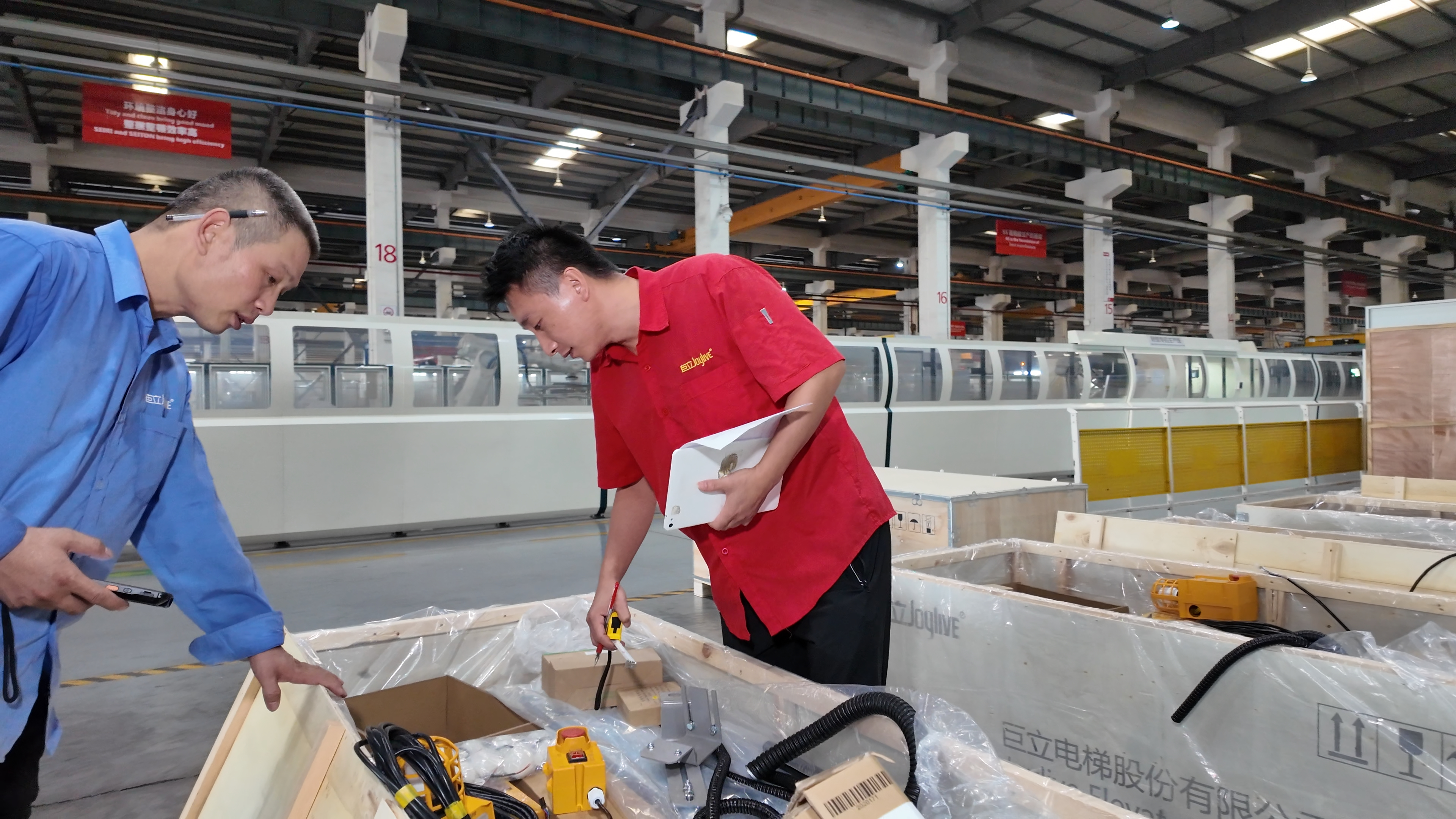
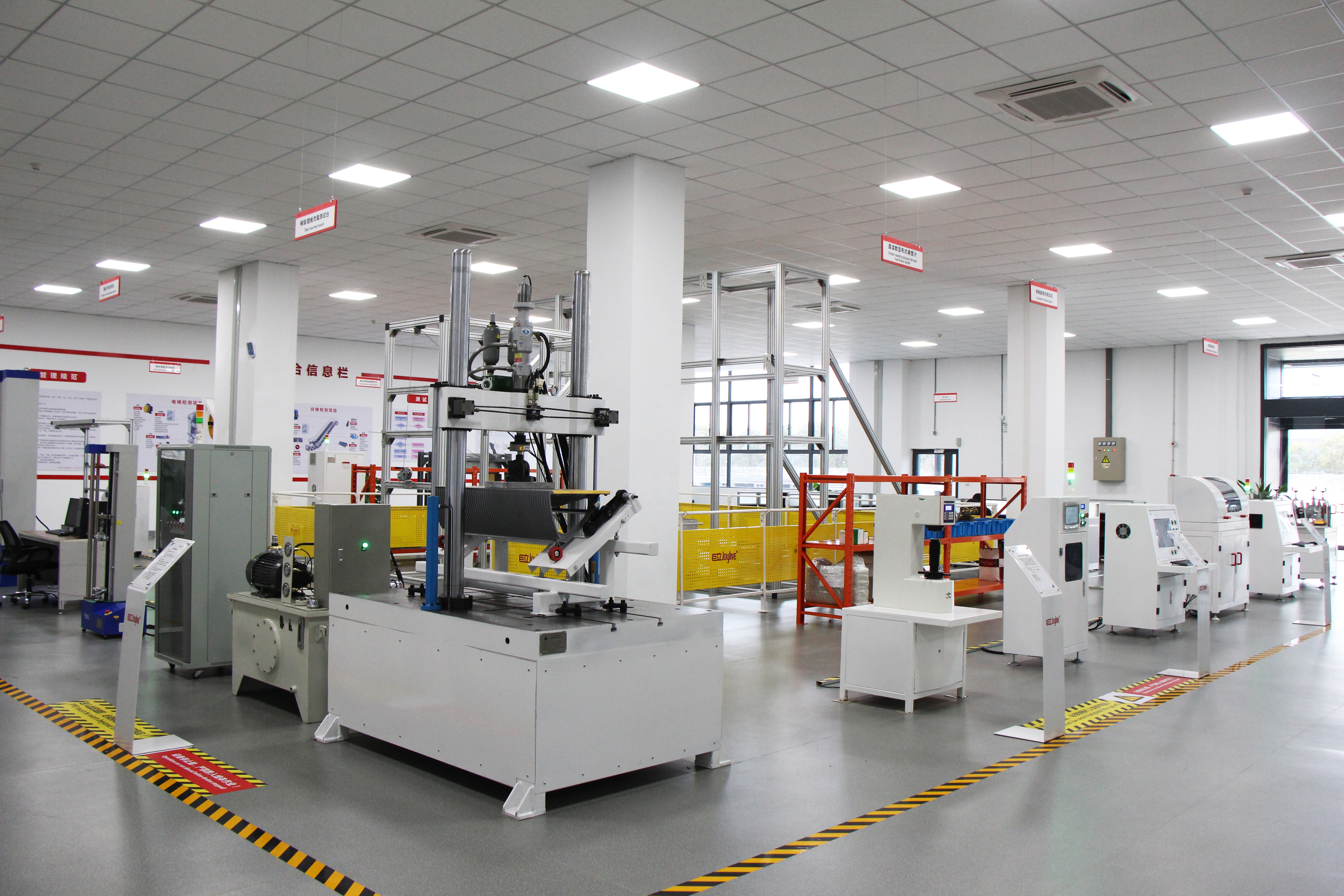
Manufacturing-side evidence supports this sequence. Joylive describes a design-review, intelligent-manufacturing and standards-compliance route for design and manufacturing risk, with robotic arms and fully automatic bending lines used to raise machining precision, and a CNAS-accredited laboratory used for whole-process quality control from design to service. For a buyer, the practical value of such statements is that they indicate which verification stages a supplier can actually support with records — not that they replace the buyer’s own acceptance plan.
Where ambiguity bites hardest: three conditional scenarios
The three situations below are illustrative constructions, not reports of specific customer projects. They show how the same framework applies to different failure modes.
Scenario A — The automated handover that “works” but is too slow
A plant specifies a smart industrial freight elevator with AGV linkage, and the contract says the interface must be “seamless”. After commissioning, the lift does connect, but the handover sequence adds time at peak hours. Because no transfer time, cycle count or measurement method was written, both parties can defend their position. The five-slot version fixes the signal sequence, defines the cycle, sets a transfer time and requires a logged trace before shipment — turning an argument into a test.
Scenario B — The oversized load that fits the rating but not the car
A buyer purchases on rated load and assumes the largest crate will fit. Rated load and internal dimensions are separate attributes; a heavy-duty freight elevator rated for the weight may still be unable to accept the dimensions or the door opening. The remedy is a criterion pair: load and dimension, each with the specific item that must be accommodated, verified against the approved general arrangement drawing at design review.
Scenario C — The dual-use assumption
A factory intends occasional passenger movement alongside goods. Some models may support dual use, subject to local safety regulations and design standards, but the applicability depends on the jurisdiction and the conformity route. A specification that assumes dual use without naming the market creates a compliance problem that no factory test can resolve. The criterion belongs at the legal review stage, before the model is fixed.
Comparing acceptance regimes: documentation-led, outcome-led, and staged
Buyers usually choose between three verification structures without naming the choice. Each allocates risk differently, and the difference matters more than the price of the lift, because it determines who pays when something is wrong.
| Dimension | Documentation-led | Outcome-led (single final test) | Staged verification (design review + factory + site) |
|---|---|---|---|
| What it actually proves | That certificates and drawings exist | That the installed system performed once, under the conditions of that day | That design intent, factory build and site installation each met a defined check |
| Evidence produced | Conformity documents, datasheets, drawings | One site test record | Design-review record, factory test report, site test sheet, handover dossier |
| When ambiguity surfaces | At handover, usually too late to change the design | After installation, when correction is most expensive | At each stage, while the correction is still a drawing or a factory adjustment |
| Who absorbs rework | Usually the buyer, because no performance was specified | Contested; depends on whether the cause is design, build or installation | Assigned by stage, because the failing stage is identified |
| Schedule behaviour | Fast to draft, slow to close | Fast to draft, high risk of a late dispute | Longer to draft, with planned hold points instead of unplanned delays |
| Suits | Simple goods-only lifts in low-consequence locations | Standard configurations with no automation interface | Integrated plants where the lift feeds production, AGVs or conveyors |
The comparison does not produce a universal winner. It produces a decision rule: the more the freight elevator is embedded in automated material flow, the more the staged regime earns its administrative cost — not because the equipment is better, but because the point of detection moves earlier. For a standalone cargo elevator in a non-automated warehouse, documentation plus a final test may be proportionate.
A second decision sits underneath the first: whether to buy on published ranges or on model-specific commitments. Published ranges are legitimate screening data and should be used that way. They become acceptance criteria only when the supplier converts the range into a model-level figure for your duty profile and signs it.
FAQ: acceptance criteria for freight elevator buyers
Which standards should a freight elevator acceptance clause cite?
Cite the framework that governs the destination market, with its edition, and name the body that will verify conformity. The relevant references include EN 81-20:2020 and EN 81-50:2020 for the EU and EEA, ISO 8100-1:2019 and ISO 8100-2:2019 internationally, ASME A17.1-2019/CSA B44-19 as a model code adopted by North American authorities, and GB/T 7588.1-2020 in China. Market access in the EU is governed by Directive 2014/33/EU; elevators in China are regulated as special equipment under the Special Equipment Safety Law of the PRC, effective 1 January 2014. A generic “international standards” phrase satisfies none of these.
How can a buyer verify AGV and IoT integration before the elevator ships?
Require three things in the contract: an interface specification listing signals, protocol and transfer-point ownership; a simulated handover test performed at the factory with a logged trace; and a defined list of monitored data fields with reporting intervals if remote monitoring is part of the scope. Supplier capability statements — including Joylive’s stated linkage between elevators and AGVs for horizontal and vertical factory transportation, and its JoyCloud platform for digital management and predictive maintenance — are useful for shortlisting, but acceptance needs a demonstration and a record rather than a description.
Do precise acceptance criteria increase the purchase price?
Precise criteria mainly change who pays for a deviation, not what the equipment costs to build. They can raise the visible price because suppliers price verification effort — witness time, factory tests, documentation and instrument calibration — and because they remove the supplier’s ability to absorb risk through vague wording. That cost appears earlier and predictably, while the alternative appears later as rework, production downtime and disputed change orders. The practical step is to ask for verification activities itemised separately in the quotation, so the cost of proof is visible rather than embedded.
What can be validated before manufacturing starts?
Design review is the cheapest verification stage and the most frequently skipped. It can confirm shaft and landing dimensions, load path and duty class, door configuration, control architecture, conformity route for the destination market, and the interface boundary with conveyors or AGVs. Component evidence, calculations and type-test documentation belong here, as does confirmation of the production controls a supplier applies — for example Joylive’s stated use of robotic arms and automatic bending lines for machining precision, and the design-to-service quality control carried out through its CNAS-accredited laboratory.
How do acceptance criteria affect delivery and handover timing?
Criteria create hold points, and hold points consume calendar time: buyer review periods, witness notice, retest windows and document approval lead times. Three clauses keep that time bounded — a fixed review period with a deemed-approval rule, a stated notice period for witnessing with a defined alternative if the buyer does not attend, and a retest window agreed in advance. This article makes no lead-time claim for any supplier or model; schedules are project-specific and should appear in the quotation with the hold points marked. If you want to align a criteria set with a specific configuration, the corporate brochure and a project discussion are the fastest route: download the Joylive brochure and request a criteria review against your duty profile.
From vague terms to a defensible acceptance plan
Freight elevator procurement problems in smart manufacturing rarely start with a bad machine. They start with a purchase order that cannot distinguish a good machine from a bad one, and with an integration boundary that nobody was required to define. The five-slot clause — attribute, condition, method, threshold, evidence with consequence — closes both gaps, and the staged verification regime moves detection to the stage where correction is still cheap.
Three actions make the difference on the next project. Convert every performance phrase into a number with a test method and a remedy. Choose a verification structure deliberately, based on how deeply the industrial elevator is embedded in automated material flow. And require model-level commitments from the supplier rather than range-level statements, since only the former can be accepted or rejected at handover.
Joylive Elevator Co., Ltd. has manufactured vertical transportation equipment since 2002, produces 15,000 units annually with a 150-engineer R&D team, exports about 55% of output, and holds a top A qualification in China for special equipment manufacturing, installation, modernization and maintenance. Its freight elevator range spans 1,000 to 20,000 kg and 0.25 to 3.0 m/s, supported by elevator professional maintenance through digital service tools and by the company’s own laboratory and manufacturing controls. Those facts are relevant to a supplier evaluation; they do not replace your acceptance plan.
Next step. Bring your draft specification, duty profile and destination market to a criteria review. The practical outputs are a clause set with defined test stages, an interface boundary list for AGV or conveyor integration, and a document list for handover.
Joylive Elevator Co., Ltd. · Corporate brochure (PDF) · [email protected] · Tel +86 178-0524-3526
Have Questions or Need More Details?
Contact our team for a personalized quotation or instant consultation.
Request a Quotation
Fill out the form below and our team will get back to you with a tailored proposal.
WhatsApp Direct Chat
Prefer to chat in real-time? Message us on WhatsApp for instant assistance & quick answers.
- Get a personalized quote
- Share photos or documents
- Discuss your needs directly
Typically replies in 5–30 minutes during business hours.