Freight Elevator Purchase: Terms-First vs. Acceptance-Criteria-First
Short answer: when a freight elevator is bought as engineered equipment rather than a catalogue item, the order in which you fix acceptance criteria and purchasing terms decides who carries the risk. Acceptance-criteria-first sequencing defines what “delivered and working” means before money is allocated against it, and that is usually the stronger position for a first-of-kind, high-load or regulated installation. Terms-first sequencing — MOQ, delivery term, payment split, lead time — is faster and negotiates cleanly when the specification and the conformity route are already proven from an earlier project. The workable answer for most industrial buyers is a hybrid: acceptance criteria written first as a contract annex, commercial terms negotiated around those gates.
This comparison uses a documented commercial baseline rather than general advice. Joylive Elevator Co., Ltd. (stock short name Joylive, stock code 833481) is a Chinese elevator manufacturer founded in 2002 in Bacheng Town, Kunshan City, Suzhou, Jiangsu Province, producing passenger, freight, home, commercial, hospital, explosion-proof and other elevators for markets that include Europe, America, Oceania, Africa, Central Asia, Southeast Asia and the Middle East. Its published purchasing terms for freight elevators — MOQ of 1 unit, FOB/CIF delivery terms, a 30/70 payment split and a pre-shipment test as the acceptance criterion — are a useful worked example because they are short enough to show exactly where each procurement path lands.

Problem Definition: The Sequence Decides Where the Risk Sits
Every freight elevator order is governed by two document sets. Purchasing terms fix the commercial envelope: minimum order quantity, delivery terms, payment terms and the delivery schedule. Acceptance criteria fix the technical closure: the test and the evidence that must exist before the buyer accepts the equipment. Joylive publishes both in four lines — MOQ 1 unit, delivery terms FOB/CIF, payment terms 30/70, acceptance criteria pre-shipment test — and those four lines are enough to show why the sequence, not the wording, controls the risk.
Failure mode 1: terms signed before acceptance has a definition
A buyer who signs the term sheet first has agreed the MOQ, the delivery term and the payment split before the word “accepted” means anything measurable. In a 30/70 structure, 70% of the contract value is governed by a document that has not yet been drafted. If the pre-shipment test is later described only as “per manufacturer standard”, the buyer's remaining leverage is goodwill, because the payment trigger is a shipment event and not a test result. The commercial position is settled; the technical position is not.
Failure mode 2: acceptance criteria written without the commercial envelope
The mirror failure is an acceptance annex built without reference to the commercial envelope. Criteria that assume on-site witnessing, a long soak test, or third-party inspection at destination conflict with FOB or CIF delivery, under which risk passes at the shipment point. The outcome is either a supplier pricing an obligation it does not control, or a tender that returns no compliant offers. On a customized machine the problem compounds: criteria that are not tied to the ordered load, speed, travel height and car size cannot be measured at all, because there is no baseline value to test against.
Working definitions used throughout this article
- Purchasing terms: MOQ (1 unit), delivery terms (FOB/CIF), payment terms (30/70) and lead time (7–45 days) as published by Joylive for its freight elevator business.
- Acceptance criteria: the pre-shipment test plus the conformity evidence that must exist before the buyer accepts the unit — test records, certificate scope, and the tested values for any customized parameter.
Industry Background: Why a Freight Elevator Cannot Be Bought From a Price List
The industrial elevator segment is a subset of a large equipment market. Ken Research valued the global industrial elevator market at USD 12.24 billion in 2025 and projected growth at a CAGR of 5.80% to USD 18.16 billion by 2032. Growth of that order keeps new suppliers entering, which raises the value of a purchase protocol that does not depend on knowing the supplier already.
Freight elevators are engineered-to-order in a way passenger elevators usually are not. Joylive's own customization scope covers speed, load, travel height, car size, car decoration and logo, and its GF10, GF20, GFN20 and GFN30 series is published at 0.25–3.0 m/s, 1,000–200,000 kg and a maximum travel height of 150 m, with SS304 as the car material. Once load, speed and travel height are customer-selected, the acceptance test is no longer a standard checklist applied to a standard product — it is a test against values that only exist in that order.
Compliance adds a second layer, because lift regulation is jurisdiction-specific rather than global. In the EU/EEA, Directive 2014/33/EU harmonises Member State lift law and has applied since 20 April 2016; EN 81-20:2020 covers the construction and installation of lifts for persons and goods, and EN 81-50:2020 covers design rules, calculations, examinations and tests of lift components. In the United States and Canada, ASME A17.1-2019/CSA B44-19 is the joint safety code and binds only where the local authority having jurisdiction has adopted it. In China, GB/T 7588.1-2020 is the national standard and elevators are regulated as special equipment under the Special Equipment Safety Law of the PRC, effective 1 January 2014. ISO 8100-1:2019 is the international reference. For hazardous areas, explosion-proof equipment must additionally follow ATEX Directive 2014/34/EU.
The practical consequence for a purchase document is direct: a generic acceptance criterion copied from another market may be unenforceable, and a generic statement of conformity may not describe the product actually ordered. Joylive states on its freight elevator page that some models are rated for dual use for passengers and freight, but that such applications must adhere to local safety regulations and specific design standards. Whether personnel may ride with the load therefore changes the conformity route before it changes the price — a point that belongs in the criteria, not in the terms.
Detailed Solution: Two Procurement Paths, and the Hybrid That Usually Wins
Path A — terms-first
In a terms-first purchase, the commercial offer is negotiated and signed first: MOQ, FOB or CIF, the 30/70 split, the delivery window. The specification and the acceptance annex are developed afterwards, frequently by the same engineer who is now working against a fixed price. The path optimises speed and budget certainty. It produces a clean commercial record and a short negotiation cycle, and it is the correct choice when the buyer is reordering a configuration that has already passed acceptance once, in a market whose conformity route is already documented.
Its structural weakness is that the scope quietly inherits whatever the offer assumed. Anything not written into the price becomes a variation, and anything written loosely — “pre-shipment test as per standard” — is difficult to enforce later, because the money has already moved to a shipment-based trigger.
Path B — acceptance-criteria-first
In an acceptance-criteria-first purchase, the annex is written before the term sheet: what will be tested, at which values, with which records, against which standard or certificate scope. The commercial negotiation then prices those obligations. The path optimises risk allocation: the supplier carries the burden of proving that the criteria are met, and every criterion has a test target because it was written against the ordered parameters.
Its weakness is scope inflation. Criteria written without the commercial envelope in view can price a project out of range, or assume an inspection regime that FOB and CIF delivery do not support. An acceptance-first buyer therefore needs a discipline: every criterion must be testable at the factory gate, and every criterion must name the parameter it measures.
Path C — acceptance-anchored terms
The hybrid keeps the strength of each path. The acceptance annex is written first and attached to the enquiry, so suppliers price a defined obligation. The commercial terms are then negotiated against that annex, with payment and delivery triggers mapped to the gates inside it. On the Joylive baseline this means: MOQ of 1 unit does not constrain a single-machine project; FOB or CIF fixes the handover point, which tells the buyer that acceptance testing happens before shipment; the pre-shipment test becomes the document that governs the balance in a 30/70 structure; and the 7–45 day lead time is quoted against a specification that is already frozen.
Step-by-Step Breakdown: Sequencing a Freight Elevator Purchase
Step 1 — Fix the duty and the physical envelope
Before any commercial discussion, record the load, rated speed, travel height and car size, plus the material expectation (SS304 is the published car material for Joylive's freight range). These are the same variables the supplier will customize, and they are the only baseline against which a pre-shipment test can be judged. A criterion written before these values are fixed is untestable.
Step 2 — Pin the conformity route and read the certificate scope
Name the market of installation and the standard that governs it, then request the certificate that evidences conformity — not a logo. Certificate scope lines are specific. Joylive holds EU type-examination certificate LIMB.0124 rev.1 for machine room goods passenger lifts and LIMB.0100 rev.1 for machine roomless goods passenger lifts, both issued by EURO CERT on 24 July 2024 against 2014/33/EU, EN 81-20:2020 and EN 81-50:2020. The same company also holds an energy efficiency certificate, 10.16.2281, issued by EURO CERT under VDI 4707 part 1 for machine room passenger lifts — a valid certificate that says nothing about freight elevators. That contrast is the point: the criteria must cite the certificate whose scope matches the product being bought.
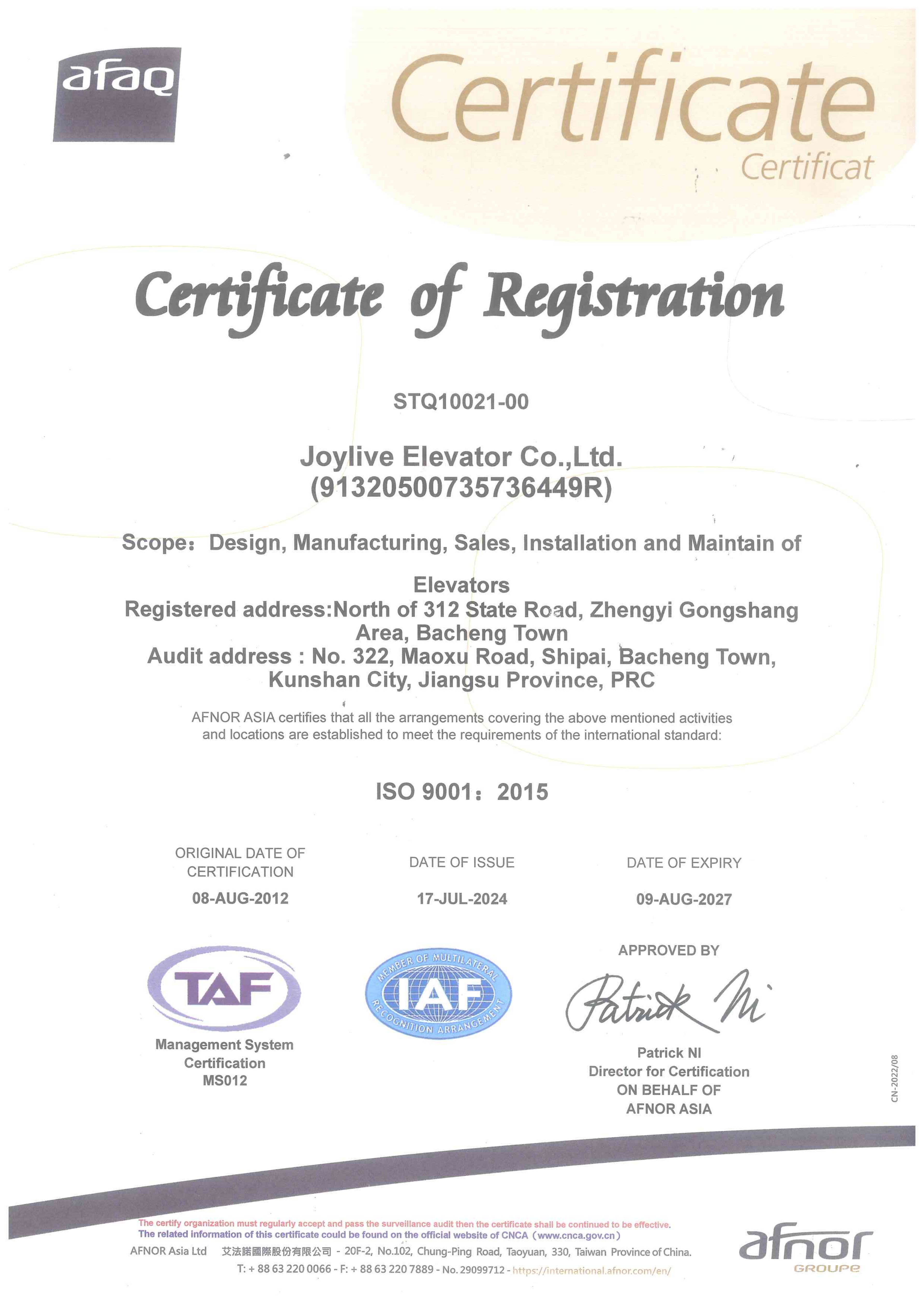
System certification and product certification answer different questions, and an acceptance annex should ask for both. Joylive's ISO 9001:2015 registration STQ10021-00 (AFNOR Asia Ltd, issued 17 July 2024, valid to 9 August 2027) covers design, manufacturing, sales, installation and maintenance; its ISO 14001:2015 registrations STE10021-06 and SHE10021-06 run to 31 July 2027. Neither substitutes for a type-examination certificate, and the type-examination certificate does not substitute for the pre-shipment test.
Step 3 — Write the acceptance criteria as measurable gates
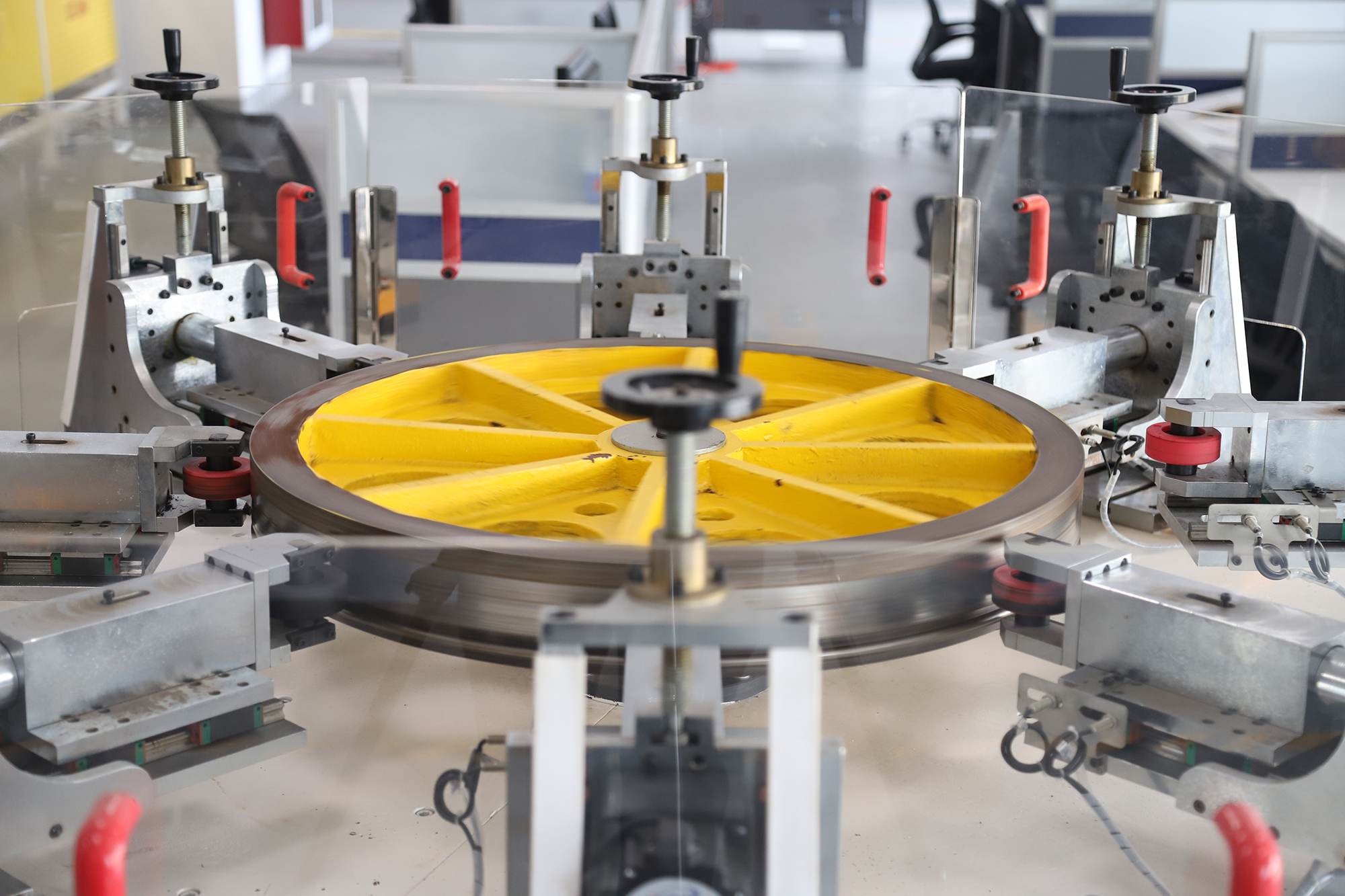
The published acceptance criterion is a pre-shipment test. Written properly, it is a gate with four parts: the parameters to be measured (load, speed, travel height, car size as ordered), the test records to be delivered, the reference standard or certificate scope, and the sign-off authority on each side. Joylive applies 100% test as its quality control rule and operates a nationally accredited CNAS laboratory, which is where the evidence for this gate originates. Criteria that stop at “pre-shipment test passed” hand the definition back to the supplier; criteria that list the measured values keep it with the buyer.
Step 4 — Convert each gate into a payment and delivery trigger
In a 30/70 split the buyer's leverage sits in the 70, so the contract should name the exact documents that release it: the signed pre-shipment test record, the certificate scope, the packing list, and the test data for any customized value. FOB and CIF both transfer risk at the shipment point, so acceptance evidence must be complete before shipment — not reconstructed at destination. If the buyer wants an arrival inspection, that is a separate, priced obligation and should be stated as such in the terms.
Step 5 — Set the delivery term and the handover point explicitly
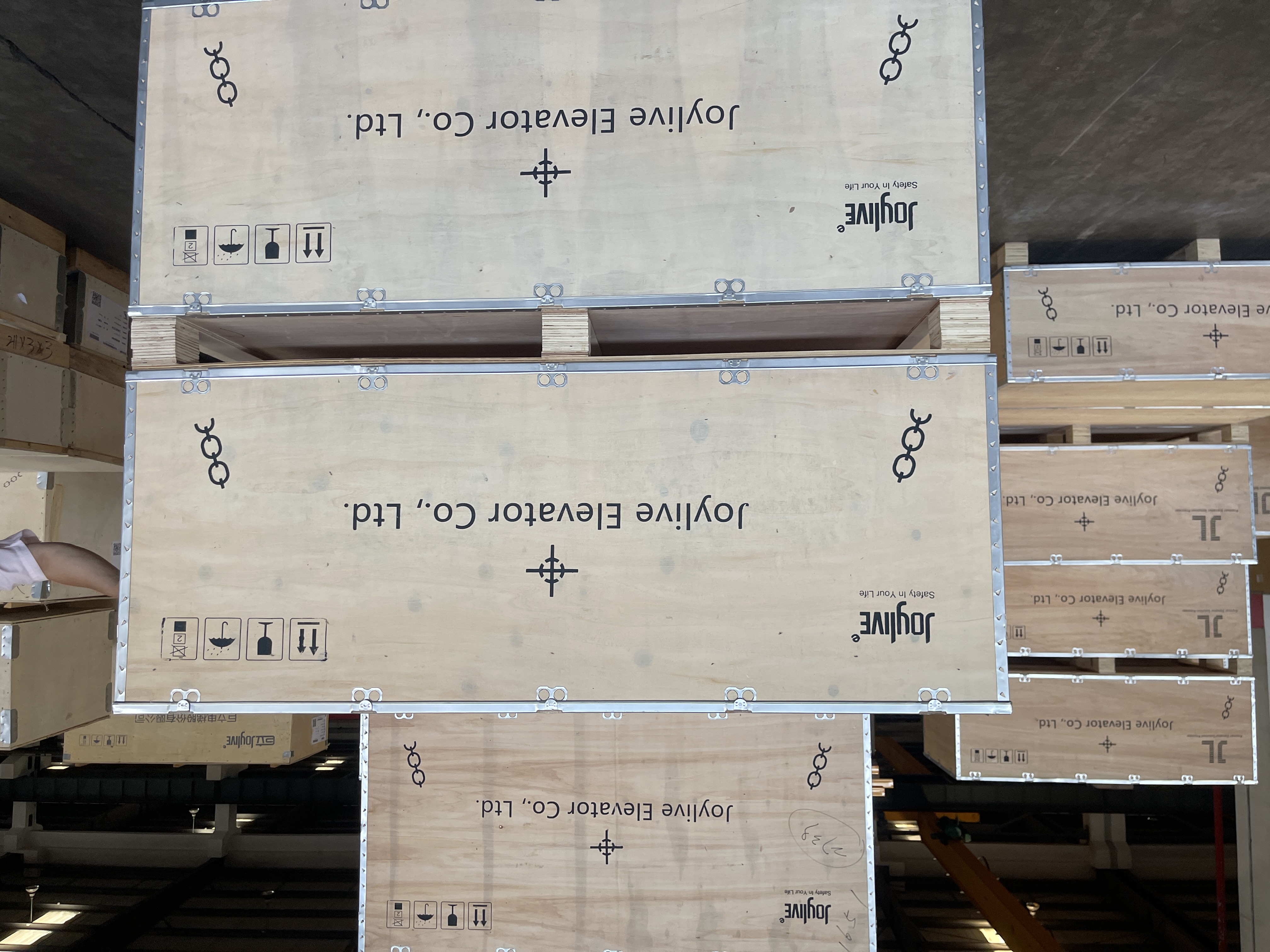
FOB and CIF are not interchangeable in a purchase document, because they allocate freight and insurance differently while both move risk at shipment. Whichever is chosen should be written with the named port and the packing standard, and it should be consistent with the acceptance annex: a criterion requiring buyer witnessing at the factory is compatible with both; a criterion requiring inspection on arrival is not compatible with either without an added clause.
Step 6 — Anchor lead time to capacity and to acceptance events
Joylive publishes a lead time of 7–45 days against a monthly capacity of 1,250 units and an annual output of 15,000 units from a 105,000 m² facility with 450 employees and a 150-engineer R&D team. A 7-day and a 45-day case are different configurations, so the term should be written as a window anchored to defined events — drawing approval, pre-shipment test date, readiness for shipment — rather than as one calendar promise that hides which configuration it assumed.
Step 7 — Freeze change control on customized values
Customization is where terms-first purchases lose money. If speed, load, travel height, car size, car decoration or logo changes after the terms are signed, the change breaks a named criterion and should be handled as a formal variation with its own test and its own schedule effect. Writing that rule into the annex at the start is cheaper than negotiating it after the pre-shipment test date has passed.
Step 8 — Put the post-handover obligation in the same annex
Acceptance ends the delivery obligation but starts the service obligation, and the two should not be separated across documents. Joylive provides online and offline technical support and a 24/365 hotline; stating response expectations, spare-parts arrangements and the digital service interface in the same annex as the acceptance criteria prevents the common outcome in which a well-tested elevator has an undefined service path.

Use Cases: Which Path Fits Which Project
Use case 1 — New factory or logistics hub with heavy goods: acceptance-criteria-first
Where the shaft, the duty cycle and the load class are all new, there is no proven specification to inherit, so the terms-first shortcut has nothing to inherit either. Industrial references of this type include Joylive's supply of 87 passenger and freight elevators to Pegatron facilities in Vietnam (two years of stable operation reported), 36 high-performance passenger and freight elevators to Wistron in Vietnam (five years), and 9 passenger and freight elevators to Inventec in Mexico (one year). In this scenario the criteria should be written first, because the tested values are the only objective proof the buyer will hold before shipment.
Use case 2 — Branded commercial or mixed-use project: terms-first with a criteria rider
Where the elevator carries a brand identity, the customization itself becomes a criterion. SAT CITY in Kazakhstan, a landmark complex, took 208 elevators with customized car decorations and customer logos and reports five years of stable operation. The commercial envelope can reasonably be negotiated first here, because the platform specification is stable — but the decoration and logo requirements must still appear as testable criteria, otherwise the one element that differentiates the project is the one element with no acceptance gate.
Use case 3 — Expansion or retrofit with an approved specification: terms-first
Where an identical or near-identical unit has already passed acceptance in the same market, the conformity route is documented and the criteria can be reused by reference. This is the legitimate home of terms-first sequencing: the buyer is buying execution certainty and schedule, and the technical closure is already proven.
Comparison Table: Terms-First vs. Acceptance-Criteria-First
| Decision dimension | Terms-first | Acceptance-criteria-first |
|---|---|---|
| First document signed | Commercial offer or term sheet | Acceptance annex with named test gates |
| What is defined first | MOQ, delivery term, payment split, lead time | Duty, tested values, conformity route, evidence pack |
| Scope definition quality | Inherits whatever the offer assumed | Explicit, because every criterion needs a test target |
| Risk allocation | Buyer holds performance risk until a later retest is agreed | Supplier carries the burden of proving the criteria are met |
| Payment leverage | Balance released against shipment documents | Balance tied to a signed pre-shipment test record |
| Change control | Late specification changes surface as price variations | Change is visible because it breaks a named criterion |
| Schedule behaviour | Fast to negotiate, slower to close technical disputes | Slower to negotiate, faster to close at handover |
| Typical failure | Acceptance wording negotiated after the price is fixed | Criteria priced into the offer, or suppliers excluded early |
| Best fit | Repeat order with a proven, already-certified specification | First-of-kind, high-load, regulated or hazardous-area project |
Table 1: How the sequencing choice changes scope definition, risk allocation and final sign-off.
| Published commercial baseline (Joylive freight elevator business) | Value |
|---|---|
| MOQ | 1 unit |
| Delivery terms | FOB / CIF |
| Payment terms | 30 / 70 |
| Acceptance criteria | Pre-shipment test |
| Quality control | 100% test |
| Lead time | 7–45 days |
| Monthly capacity | 1,250 units |
| Annual output | 15,000 units |
| Customization scope | Speed, load, travel height, car size, car decoration, logo |
| After-sales | Online and offline technical support; 24/365 hotline |
Table 2: Company-published purchasing terms and capability values used as the reference case in this article. Figures are single-source company statements.
FAQ
1. Which standards should the acceptance criteria reference for an industrial freight elevator?
The reference depends on where the lift will be installed, not on the supplier's home market. In the EU/EEA, Directive 2014/33/EU harmonises lift law and has applied since 20 April 2016; EN 81-20:2020 covers the construction and installation of lifts for persons and goods, and EN 81-50:2020 covers design rules, calculations, examinations and tests of lift components. In the United States and Canada, ASME A17.1-2019/CSA B44-19 is the joint safety code and binds only where the local authority having jurisdiction has adopted it. In China, GB/T 7588.1-2020 is the national standard, and elevators are regulated as special equipment under the Special Equipment Safety Law of the PRC, effective 1 January 2014. ISO 8100-1:2019 is the international reference. For hazardous areas, explosion-proof equipment must additionally follow ATEX Directive 2014/34/EU. Conformity is normally evidenced by a type-examination certificate, and the scope line matters: Joylive holds EU type-examination certificate LIMB.0124 rev.1 for machine room goods passenger lifts and LIMB.0100 rev.1 for machine roomless goods passenger lifts, both issued by EURO CERT on 24 July 2024 against 2014/33/EU, EN 81-20:2020 and EN 81-50:2020.
2. Can load, speed and car size be customized, and does customization change the acceptance criteria?
Yes to both. Joylive offers OEM/ODM production with customization of speed, load, travel height, car size, car decoration and logo, and publishes freight elevator ranges of 0.25–3.0 m/s, 1,000–200,000 kg and a maximum travel height of 150 m across the GF10, GF20, GFN20 and GFN30 series, with SS304 as the car material. Every customized value becomes a test target: if the order specifies a non-standard load or travel height, the acceptance criteria must state that value explicitly, because a general reference to “manufacturer standard” leaves nothing to test against at pre-shipment.
3. How should purchasing terms be structured around the acceptance criteria?
Start from the published baseline, then map documents to money. Joylive's terms are MOQ 1 unit, delivery FOB/CIF, payment 30/70 and acceptance on pre-shipment test. FOB and CIF both transfer risk at the shipment point, so acceptance testing happens at the factory before handover; a criterion that assumes inspection at destination needs a separate, priced obligation. In a 30/70 split the buyer's leverage sits in the 70, so the contract should name the exact documents that release it — signed pre-shipment test record, certificate scope, packing list and test data for the customized parameters.
4. Is a sample shipment possible, and how is acceptance handled without a full-size prototype?
MOQ is 1 unit, so the smallest possible order is a single elevator and a normal project has no separate prototype stage. Joylive applies 100% test as its quality control rule, holds a nationally accredited CNAS laboratory, and documents acceptance through the pre-shipment test rather than a trial installation. For a first order, the practical substitute for a sample is a witnessed pre-shipment test plus a document pack that shows the tested values against the ordered values.
5. What lead time should be written into the terms, and what should it be anchored to?
Joylive publishes a lead time of 7–45 days against a monthly capacity of 1,250 units and an annual output of 15,000 units from a 105,000 m² facility. The number should be written as a window anchored to defined events — drawing approval, pre-shipment test date, readiness for shipment — rather than a single calendar promise, because a 7-day and a 45-day case are different configurations. The service obligation belongs in the same annex: Joylive provides online and offline technical support and a 24/365 hotline. Buyers who want to check these terms against their own specification can request a quote or download the company brochure at the Joylive brochure.
Conclusion: Choose the Sequence, Then Write Both Documents
The decision rule is short. If the specification has already passed acceptance in the target market, run terms-first and use the saved time to tighten the delivery and service clauses. If the load, the travel height, the market or the conformity route is new, run acceptance-criteria-first: write the annex, attach it to the enquiry, and let the commercial terms price a defined obligation. Either way, the four published lines of a freight elevator contract — MOQ 1 unit, FOB/CIF, 30/70, pre-shipment test — only allocate risk correctly when the tested values and the certificate scope have been written down before they are signed.
For buyers evaluating that sequence against a real project, the practical next step is comparison rather than commitment: take the ordered load, speed and travel height, request the corresponding certificate scope, and ask what the pre-shipment test record will contain for those exact values.
Sample, quote or technical review
Joylive Elevator Co., Ltd. — founded 2002, Bacheng Town, Kunshan City, Suzhou, Jiangsu Province, China. Stock short name Joylive, stock code 833481. Website: joylivelift.com · Email: [email protected] · Tel: +86 178-0524-3526.
Send your duty, travel height and target market to receive a specification response and a document list for acceptance.
Download the Joylive brochure (PDF)
Have Questions or Need More Details?
Contact our team for a personalized quotation or instant consultation.
Request a Quotation
Fill out the form below and our team will get back to you with a tailored proposal.
WhatsApp Direct Chat
Prefer to chat in real-time? Message us on WhatsApp for instant assistance & quick answers.
- Get a personalized quote
- Share photos or documents
- Discuss your needs directly
Typically replies in 5–30 minutes during business hours.