Passenger Elevator Tender Compliance: A Region-by-Region Guide to Certifications and Standards
Passenger Elevator Tender Compliance: A Region-by-Region Guide to Certifications and Standards
Passenger elevator tender compliance is decided by documents, not by drawings. In most evaluations, a technically suitable offer is set aside because the certificate class does not match the standard the tender names, because the certificate scope describes a different lift type, or because the certificate expires before project handover.
A tender-ready compliance dossier answers four questions in sequence: which standard or directive governs this specific project; which certificate class proves conformity to it; whether that certificate names the model and configuration being offered; and whether it stays valid at submission, delivery and handover.
The sections below map those questions across European, North American and tender-specified markets, then show how a dossier is assembled, verified and handed to an evaluation committee.
Joylive Elevator Co., Ltd. (stock short name: Joylive, stock code: 833481) is a Chinese elevator manufacturer founded in 2002 in Bacheng Town, Kunshan City, Suzhou, Jiangsu Province. The company operates a 105,000 m² facility with 450 employees, an R&D team of 150 engineers and an annual output of 15,000 units, producing passenger elevators, home lifts, freight elevators, panoramic elevators, hospital elevators and fire elevators. Approximately 55% of output is exported to Europe, America, Oceania, Africa, Central Asia, Southeast Asia and the Middle East. Its published certificates are used throughout this guide as a concrete example of what a verifiable compliance record contains — not as a claim that one certificate set fits every tender.
The Real Failure Modes in Passenger Elevator Tenders
Compliance rejections rarely come from an unknown rule. They come from evidence that does not survive a second reading. The patterns below account for most clarification requests during tender review.
- Class mismatch. The tender asks for an EU type-examination certificate under Directive 2014/33/EU, and the supplier submits a voluntary conformity certificate or a component test report. These documents serve different purposes and are not interchangeable.
- Lift-type mismatch. Machine-room and machine-roomless lifts sit in separate certificate scopes. A certificate for a machine-room passenger lift does not cover a machine-roomless configuration, even when both are 1000 kg / 1.75 m/s machines.
- Standard-version mismatch. A dossier citing EN 81-20:2014 evidence against a tender that specifies EN 81-20:2020 invites a clarification cycle that can cost weeks.
- Validity mismatch. Certificates with recorded expiry dates must still be valid at submission and, in many contracts, at handover.
- Configuration drift. Energy classes attach to a specific load and speed combination. A result recorded for 1000 kg / 1.75 m/s does not transfer to a heavier or faster specification.
- Life-safety assumptions. Firefighter lift performance is proven by dedicated certificates referencing EN 81-72:2020 and EN 81-77:2022, not by the general passenger lift certificate.
- Management-system scope gaps. Quality and environmental registrations are written against specific scopes. Where installation and maintenance sit on a different certificate from design and manufacturing, both documents belong in the dossier.
Industry Background: Why Compliance Evidence Carries More Weight Now
Elevator procurement has become more document-intensive because the market it serves is large, standardised and ageing at the same time. Global Market Insights estimated the global elevator market at USD 84.8 billion in 2024, projected to reach USD 126.7 billion by 2034. Passenger elevators dominated installations in 2025 with more than 70% of annual volume, according to Maximize Market Research, while Asia-Pacific leads with over 66% of installation volume.
Two structural factors push documentation to the front of the evaluation. First, traction technology accounts for roughly 71–72% of global installations because of its energy efficiency advantage over hydraulic systems, which raises the weight of energy evidence in tenders. Second, modernisation demand keeps growing: Roland Berger and Maximize Market Research note that over 50% of units in Europe and North America exceed 15–18 years of service life, and modernisation packages are judged on the documentation a supplier can produce for an existing shaft as much as on the equipment itself. Market concentration reinforces the same point from the buyer side — Schindler led the global elevator market in 2024 with a share above 11%, according to Global Market Insights — so for buyers evaluating suppliers outside the largest groups, verification quality becomes the practical differentiator.
Residential demand adds a separate checklist. The global home elevator market was valued at USD 8.24 billion in 2024 and is expected to grow at a CAGR of 7.2% to 2034, based on Zion Market Research, which is why villa and private-residence tenders increasingly arrive with their own documentation requirements rather than inheriting commercial passenger elevator requirements.
Region-by-Region Certification Mapping
Almost every passenger elevator tender contains three verification layers: the product conformity route, the energy performance evidence, and the manufacturer's management-system registrations. Which documents satisfy the first layer depends entirely on the market where the lift will be installed.
European Union and EEA Projects
In the EU and EEA, lifts are placed on the market under Directive 2014/33/EU. The harmonised standards referenced in practice are EN 81-20:2020 for construction and installation and EN 81-50:2020 for testing and components; the CEN and KONE market reference describes these two standards as the framework governing the modern elevator industry.
Joylive's published set shows how the evidence divides by lift type and standard edition:
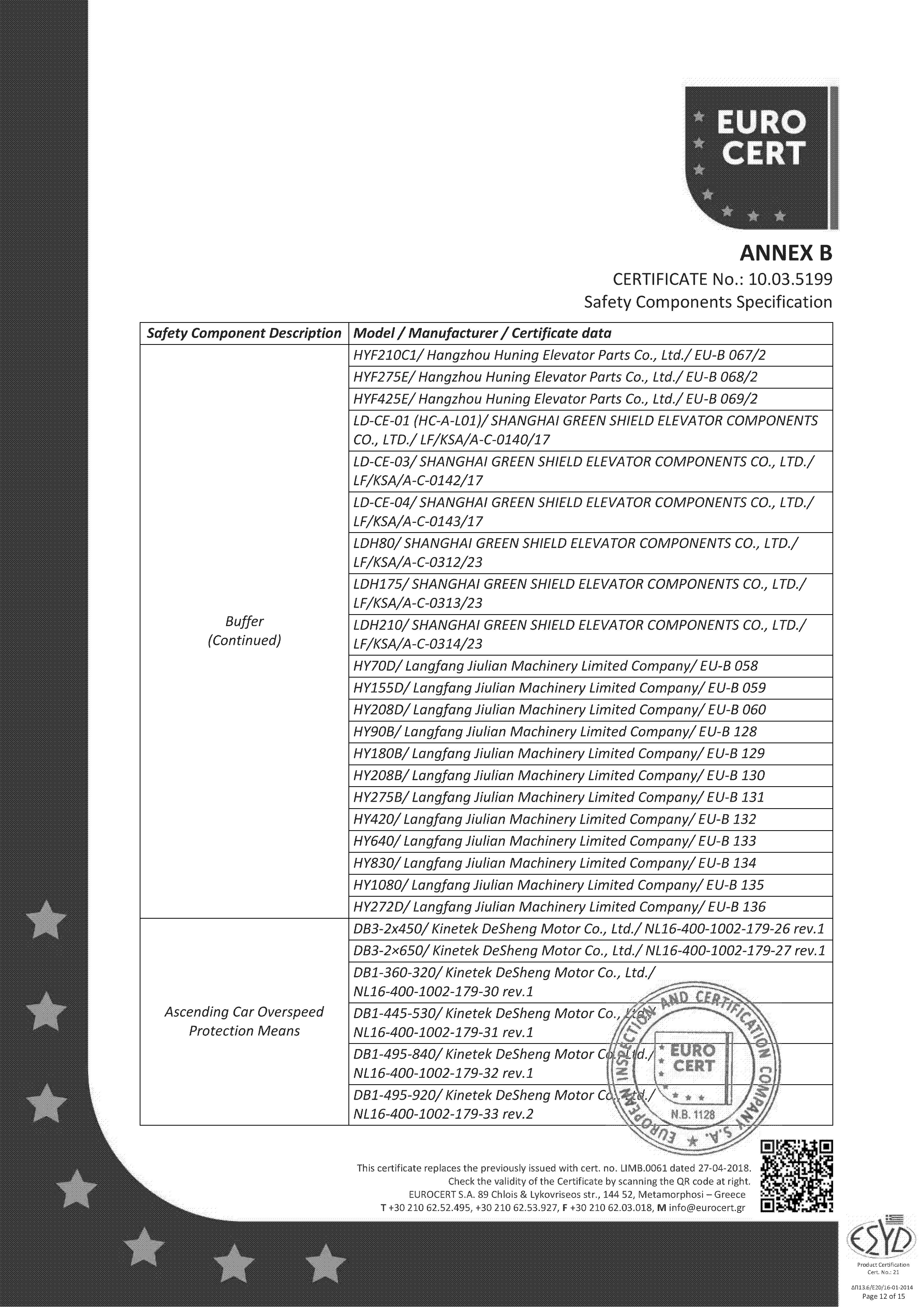
- Machine-room passenger lift — EU type-examination certificate 10.03.5199 (EURO CERT), issued 20 December 2024 under 2014/33/EU, EN 81-20:2020 and EN 81-50:2020.
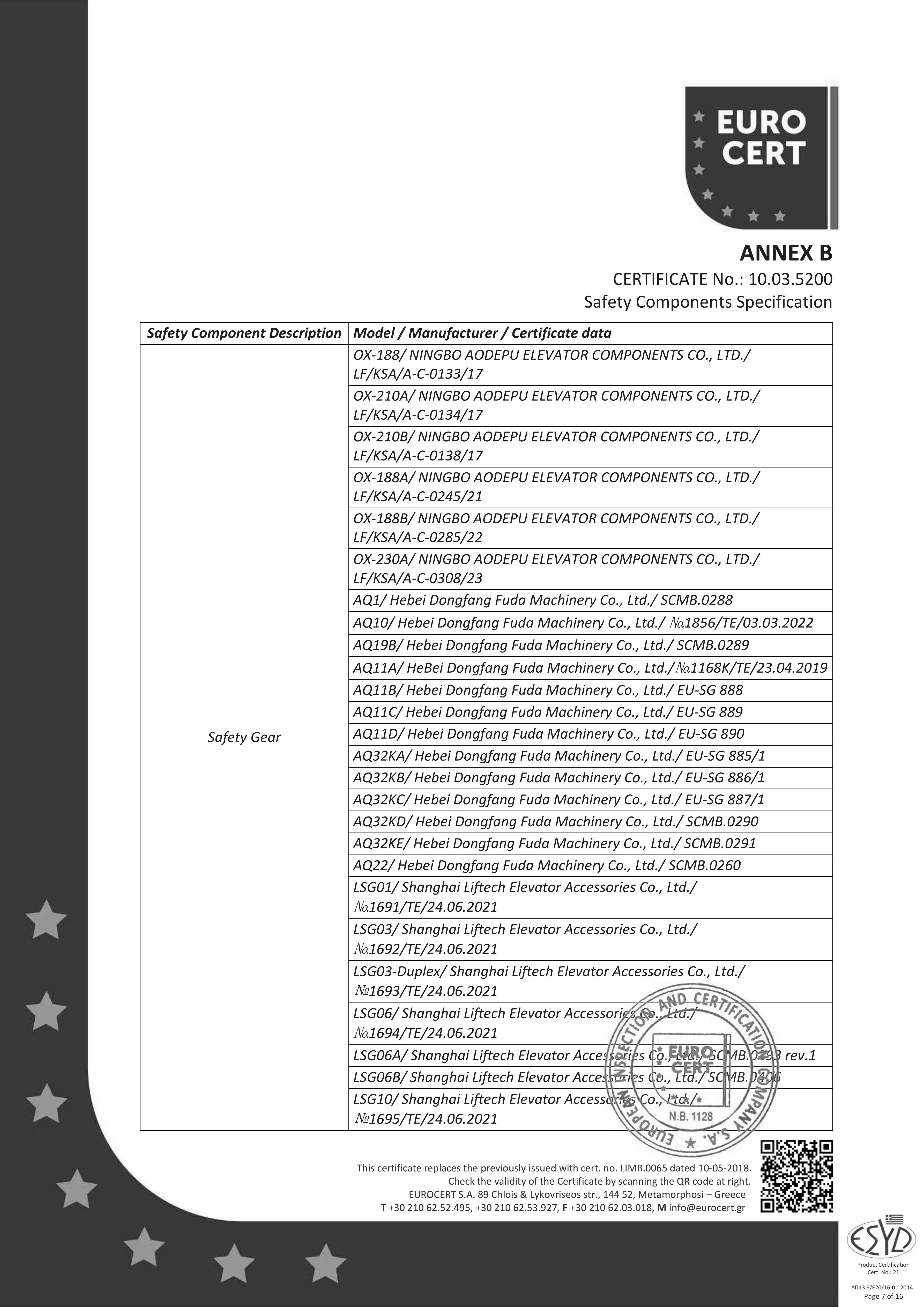
- Machine-roomless passenger lift — EU type-examination certificate 10.03.5200 (EURO CERT), issued 20 December 2024 under the same directive and standard editions.
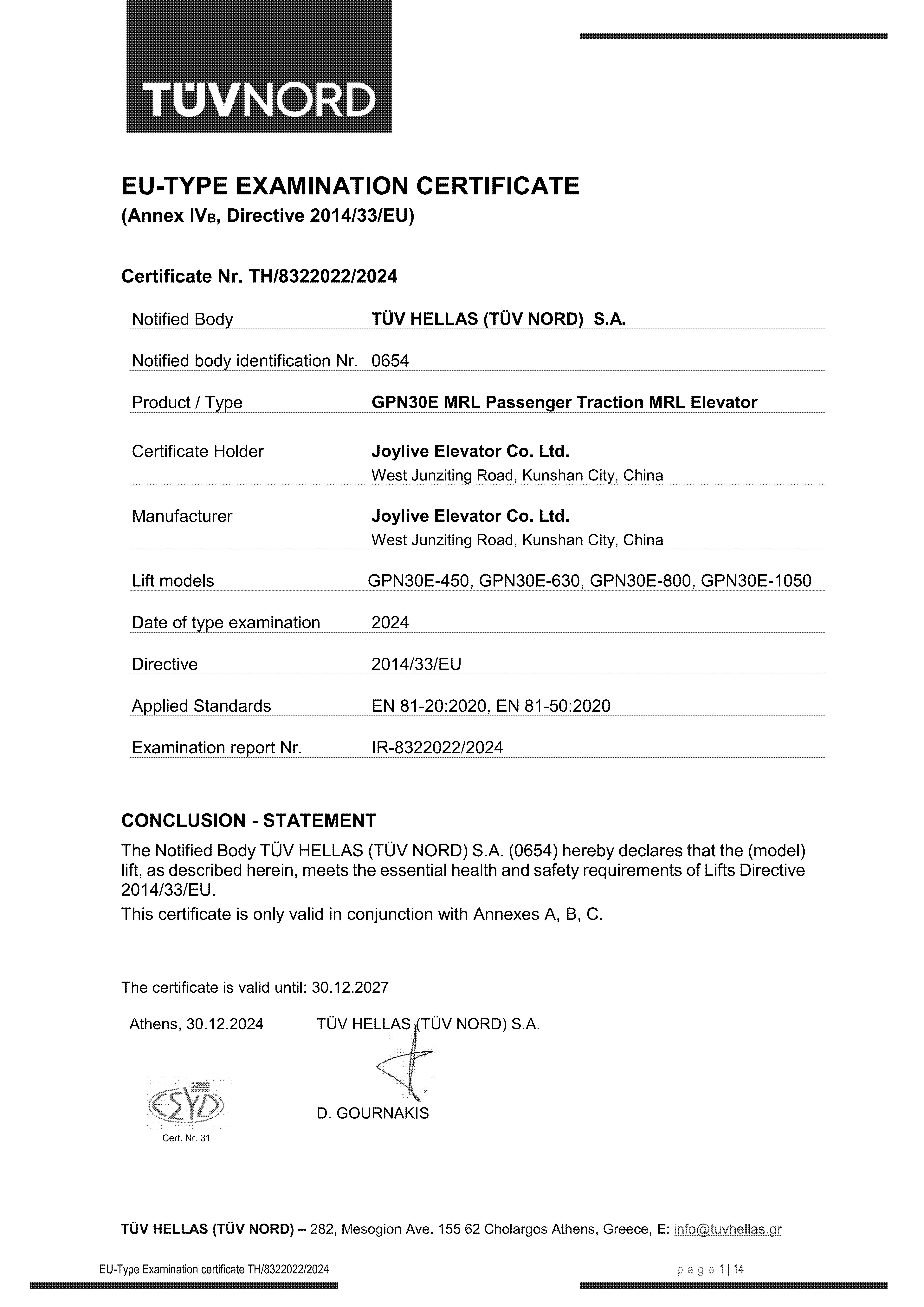
- MRL passenger traction lift — EU type-examination certificate TH/8322022/2024 (TUV), issued 30 December 2024 for the GPN30E MRL passenger traction lift under EN 81-20:2020 and EN 81-50:2020, with a recorded expiry of 30 December 2027.
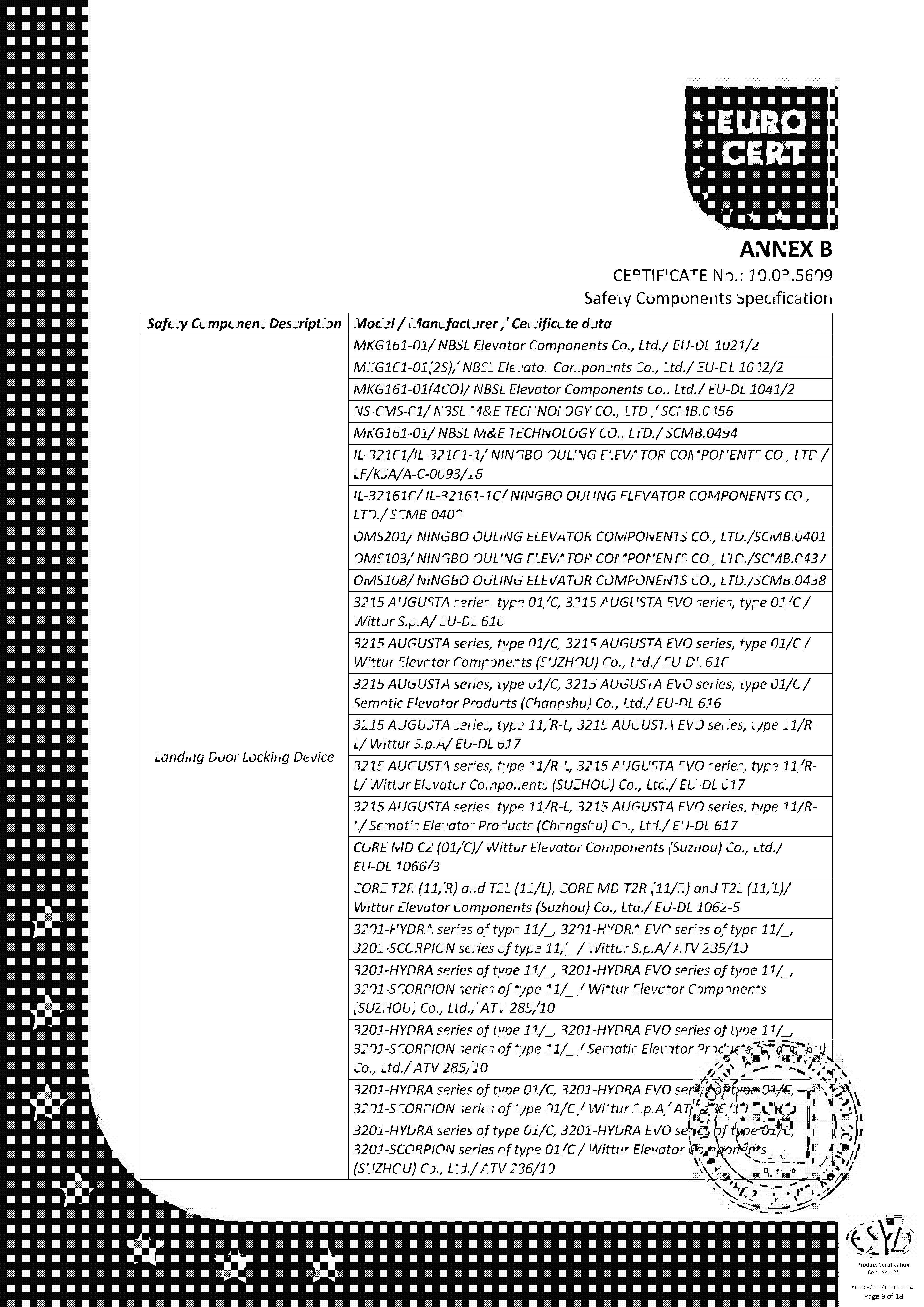
- Firefighter lifts — EU type-examination certificates 10.03.5609 (machine room) and 10.03.5610 (machine-roomless), issued 17 September 2025 under 2014/33/EU, EN 81-20:2020, EN 81-50:2020, EN 81-72:2020 and EN 81-77:2022.
- Goods passenger lift — EU type-examination certificate LIMB.0124 rev.1 (EURO CERT), issued 24 July 2024 under 2014/33/EU, EN 81-20:2020 and EN 81-50:2020.
- Earlier-generation passenger lift certificates — LIMB.0061 (machine room, issued 27 April 2018, recorded expiry 26 April 2028) and LIMB.0065 (machine-roomless, issued 10 May 2018, recorded expiry 9 May 2028), both referencing EN 81-20:2014.
The last item matters more than it appears. A tender that specifies EN 81-20:2020 is asking for the 2020 edition. Certificates referencing EN 81-20:2014 remain useful evidence of continuity and of a long product record, but they do not, on their own, satisfy a 2020-edition requirement. Buyers should ask which edition each certificate invokes instead of accepting a certificate count.
Energy Evidence Is a Separate Certificate Class
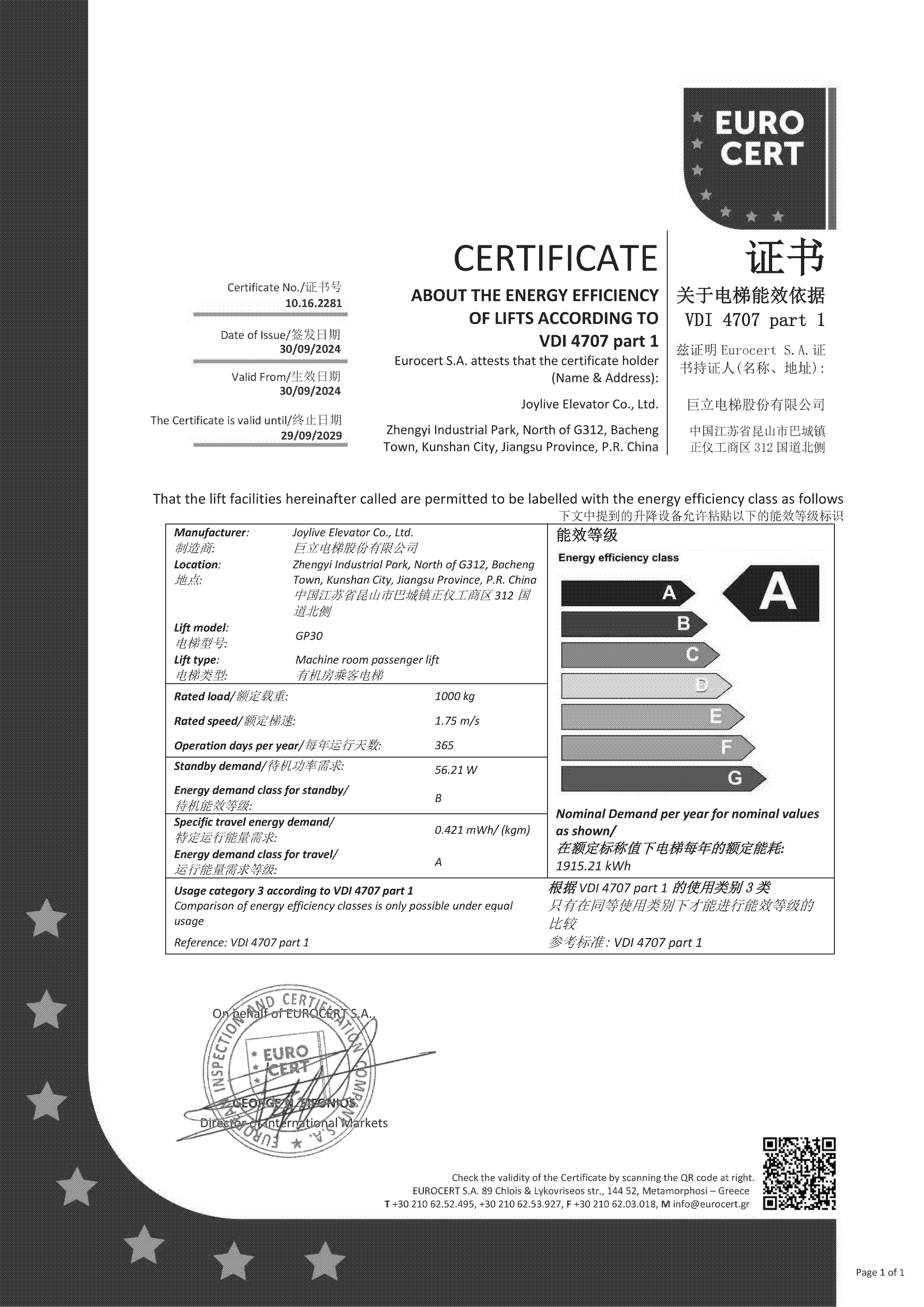
Energy performance is not covered by the type-examination route, and this is where many dossiers thin out. Two certificate families appear in Joylive's set, both issued by EURO CERT on 30 September 2024 with a recorded expiry of 29 September 2029 for a machine-room passenger lift rated 1000 kg / 1.75 m/s:
- Certificate 10.16.2281 against VDI 4707 part 1.
- Certificate 10.16.2280 against ISO 25745-2:2015.
Both documents record the load and speed of the tested configuration. When a tender specifies an energy class, the buyer should confirm that the certificate's load and speed match the offered specification, because the certificate covers a configuration rather than a product family in the abstract.
North American Projects
Elevator safety in North America is primarily regulated under ASME A17.1-2025 / CSA B44, the Safety Code for Elevators and Escalators published by ASME. That is a different regulatory route from the EU Lifts Directive. An EU type-examination certificate issued under 2014/33/EU is evidence of European conformity; it is not, by itself, evidence of conformity with ASME A17.1-2025 / CSA B44 or with the acceptance requirements of a local authority having jurisdiction.
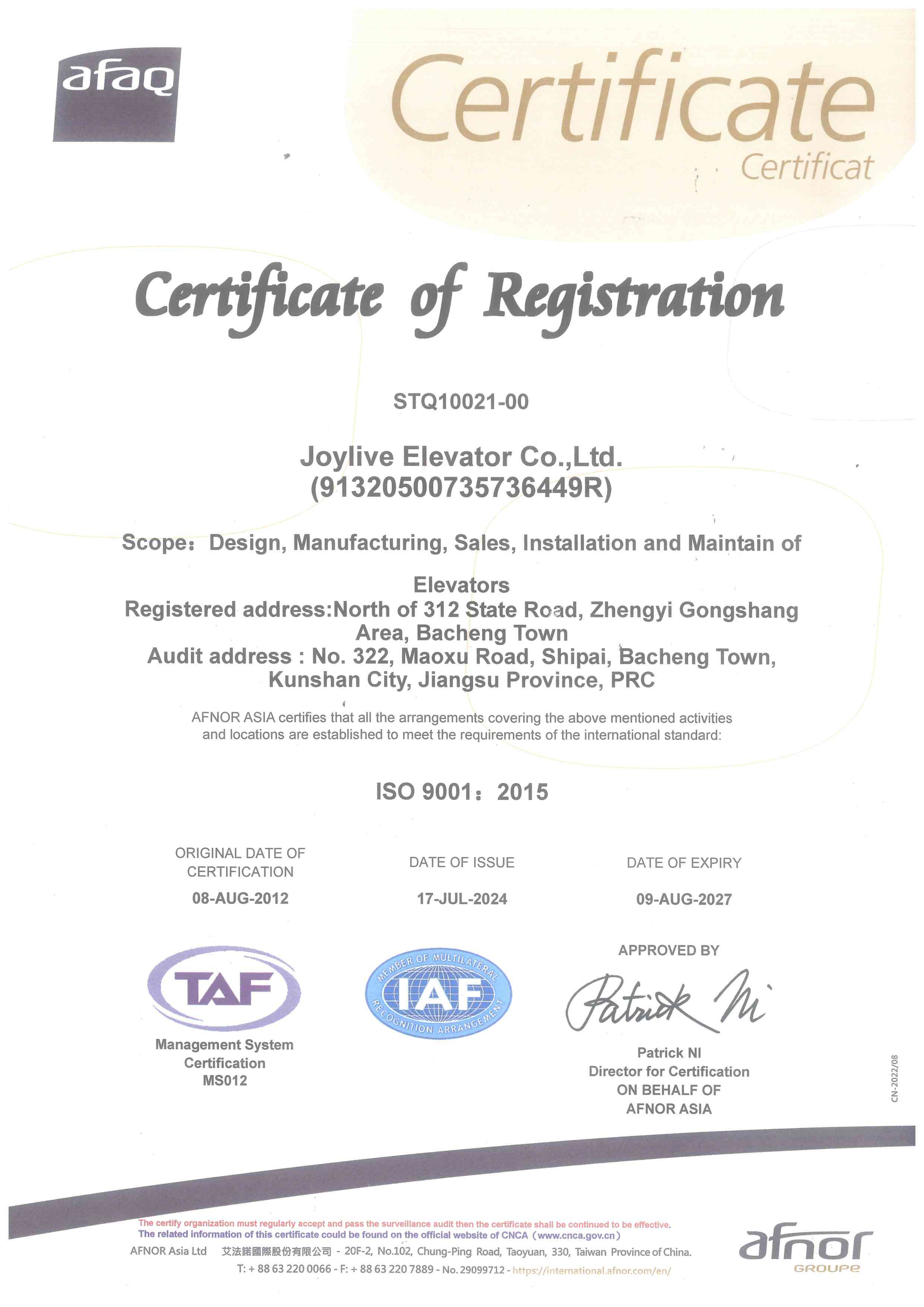
A North American compliance annex should therefore pair the manufacturer's code documentation for the specific jurisdiction with management-system registrations that cover the full activity chain. Joylive's records include ISO 9001:2015 registration STQ10021-00 and registration SHQ10021-05 against GB/T 19001-2016 + GB/T 50430-2017, both scoped to design, manufacturing, sales, installation and maintenance of elevators, issued 17 July 2024 by AFNOR Asia Ltd and valid to 9 August 2027. Environmental coverage is split across two registrations against ISO 14001:2015 — STE10021-06 for design, manufacturing and sales, and SHE10021-06 for installation and maintenance — both issued 26 July 2024 and valid to 31 July 2027. When a tender asks for installation-stage environmental controls, the installation and maintenance scope is the one that answers the clause.
Markets Where the Tender Names Its Own Code
Joylive's export markets — Europe, America, Oceania, Africa, Central Asia, Southeast Asia and the Middle East — include many jurisdictions where the governing document is the code or client specification written into the tender itself. In these tenders the dossier is assembled against the named clause, and verification becomes mechanical rather than interpretive.
- Identify the certificate class the clause names, and reject substitutes that only look similar.
- Match the certificate scope text to the offered lift type and model.
- Confirm the issuing body — the certificates in this set were issued by EURO CERT, TUV and AFNOR Asia Ltd — and verify the certificate number directly with that body rather than through a brochure.
- Record issue and expiry dates against submission, delivery and handover milestones.
| Market / equipment type | Framework named in the tender | Core documents to verify | Verification checkpoint |
|---|---|---|---|
| European Union / EEA | Directive 2014/33/EU, with EN 81-20:2020 and EN 81-50:2020 as the harmonised standards for construction and installation, and testing and components respectively | EU type-examination certificate naming the lift type and model; declaration of conformity | Does the certificate reference the 2020 editions of EN 81-20 and EN 81-50, and is it valid at submission and handover? |
| North America | ASME A17.1-2025 / CSA B44 Safety Code for Elevators and Escalators | Code documentation for the specific jurisdiction plus management-system registrations covering design, manufacturing, sales, installation and maintenance | EU type-examination is issued under 2014/33/EU and does not replace the ASME A17.1 / CSA B44 route |
| Other export markets (Middle East, Africa, Central Asia, Southeast Asia, Oceania) | The code or client specification named in the tender document itself | Certificate class requested by the tender; ISO 9001 / ISO 14001 registrations; project-specific test documentation | Does the offered model appear in the certificate scope, and can the authority verify the certificate number directly? |
| Energy-focused tender (any market) | VDI 4707 part 1; ISO 25745-2:2015 | Energy efficiency certificate for the specified load and speed combination | The certificate records load and speed (for example 1000 kg / 1.75 m/s); a class recorded for another configuration does not transfer |
| Firefighter / evacuation lift (EU framework) | EN 81-72:2020 and EN 81-77:2022, read with EN 81-20:2020 and EN 81-50:2020 | Firefighter lift EU type-examination certificate for the correct configuration | Machine-room (10.03.5609) and machine-roomless (10.03.5610) firefighter lifts hold separate certificates — match the certificate to the configuration offered |
Home Lift and Commercial Passenger Elevator: Two Compliance Footprints
Home lift tenders and commercial passenger elevator tenders look similar on paper and are not. The Home Lift GH30 is rated 0.25–1.75 m/s with a load range of 200–1150 kg, a maximum travel height of 30 m and SS304 car material, and is specified for villas and private residences. The Passenger Elevator GP30 and GPN30 cover 1.0–8.0 m/s, 630–3000 kg and up to 350 m of travel, serving residential buildings, hotels, hospitals, transport hubs, schools, office buildings, infrastructure, factories and logistics parks.
The evidence base differs as well. The EU type-examination certificates in the published set address machine-room and machine-roomless passenger lifts, goods passenger lifts and firefighter lifts. The home lift appears in the management-system scope instead — registration SHQ10021-05 lists the Home Lift GH30 among its applicable products alongside freight and passenger elevators. The practical consequence for buyers is a different checklist per category: a home lift dossier is built around the manufacturer's quality registration, the product specification and project-specific safety documentation, while a commercial passenger elevator dossier adds the EU type-examination certificate, the energy certificate matching the specified load and speed, and, where relevant, the firefighter lift certificates. Where a project mixes both categories — a residential tower with villa-style units, for example — the tender should list the two evidence sets separately.
| Compliance dimension | Home Lift (GH30) | Passenger Elevator (GP30, GPN30) |
|---|---|---|
| Specified application | Villas and private residences | Residential buildings, hotels, hospitals, transport hubs, schools, office buildings, infrastructure, factories, logistics parks |
| Speed range | 0.25–1.75 m/s | 1.0–8.0 m/s |
| Rated load | 200–1150 kg | 630–3000 kg |
| Maximum travel height | 30 m | 350 m |
| Car material recorded | SS304 | SS304 |
| EU type-examination coverage in the published set | Not among the passenger-lift EU type-examination certificates listed in this guide; home lift covered through management-system registration | Machine-room and machine-roomless passenger lifts, goods passenger lift and firefighter lifts, under 2014/33/EU with EN 81-20:2020 and EN 81-50:2020 |
| Quality and environmental registrations | Listed among applicable products of registration SHQ10021-05 (GB/T 19001-2016 + GB/T 50430-2017) | Covered by STQ10021-00 and SHQ10021-05 (ISO 9001:2015, GB/T 19001-2016 + GB/T 50430-2017), with ISO 14001:2015 registrations SHE10021-06 and STE10021-06 |
| Typical tender evidence requested | Management-system registration, product specification sheet, project-specific safety documentation | EU type-examination certificate, energy efficiency certificate for the specified configuration, management-system registrations, firefighter lift certificate where applicable |
Building the Tender-Ready Compliance Dossier: Seven Steps
The sequence matters. Teams that price the package before the compliance annex is frozen usually renegotiate both.
- Extract the compliance clause verbatim. Copy the exact standard reference, any directive number such as 2014/33/EU, and any performance requirement such as an energy class or a firefighter function. Paraphrasing the clause at this stage is how class mismatches enter the dossier.
- Convert the clause into a certificate class. Type-examination, declaration of conformity, energy certificate and management-system registration are four different documents. Decide which one the clause actually demands before requesting anything from a supplier.
- Verify certificate identity and scope. Read the certificate number, the issuing authority, the scope text, the standard edition and the model reference together. Certificate TH/8322022/2024 names the GPN30E MRL passenger traction lift; certificates 10.03.5199 and 10.03.5200 separate machine-room and machine-roomless passenger lifts. A certificate that does not name the offered type is not evidence for that type.
- Check validity windows against project milestones. Compare recorded issue and expiry dates with the submission date, delivery date and handover date. In this set, TH/8322022/2024 carries a recorded expiry of 30 December 2027, LIMB.0061 and LIMB.0065 run to 26 April 2028 and 9 May 2028, the energy certificates 10.16.2281 and 10.16.2280 run to 29 September 2029, and the management-system registrations expire between 31 July 2027 and 9 August 2027.
- Separate energy claims from safety claims. The VDI 4707 part 1 and ISO 25745-2:2015 certificates apply to a load and speed configuration. If the tender's specified configuration differs, the certificate must be matched or the requirement clarified in writing.
- Confirm life-safety coverage explicitly. Firefighter lift projects require certificates that reference EN 81-72:2020 and EN 81-77:2022 in addition to EN 81-20:2020 and EN 81-50:2020, for the correct machine-room or machine-roomless configuration.
- Map every certificate to the offered configuration, then freeze the record. Confirm the offered speed, load and travel height sit inside the certified scope — 1.0–8.0 m/s, 630–3000 kg and up to 350 m for the Passenger Elevator GP30 and GPN30, and 0.25–1.75 m/s, 200–1150 kg and up to 30 m for the Home Lift GH30. Note who verified each document, on which date, against which clause, and keep that log with the submission.
Use Cases: Where a Complete Dossier Changes the Outcome
Compliance evidence is easiest to defend when it connects to projects that already operate in the target market. The references below are drawn from Joylive's delivered project record and show the spread of equipment types, regions and operating periods that a dossier may need to document.
- Transport hub — San Luis Potosí International Airport, Mexico. A customised panoramic elevator was supplied for the terminal, with stable operation recorded for 8 years.
- Healthcare — Crimea Clinical Hospital, Russia. 14 elevators including heavy-duty hospital elevators and passenger elevators, with stable operation recorded for 8 years.
- Education — Indus University, Pakistan. 3 intelligent group-controlled passenger elevators, with stable operation recorded for 9 years.
- High-rise mixed use — The Sands Apartment & Mall, Panama. 12 commercial elevators supplied for a 42-storey building, with stable operation recorded for 6 years.
- Mixed-use landmark — SAT CITY, Kazakhstan. 208 elevators with customised car decoration and client logos, with stable operation recorded for 5 years.
- Government residential programme — Uzbekistan. 688 elevators supplied for a government-led residential project, with stable operation recorded for 8 years.
- Villa residential — Desa Mountain Villa, Malaysia. 120 home elevators, with stable operation recorded for 13 years.
In tender terms, these records support the durability and after-sales side of the risk assessment: equipment installed across Europe, America, Asia, the Middle East and Oceania, with operating periods recorded between 5 and 13 years for the projects listed.
Frequently Asked Questions
Which certificates should a supplier provide for a passenger elevator tender governed by EU rules?
For EU and EEA projects, the core document is an EU type-examination certificate issued under Directive 2014/33/EU against EN 81-20:2020 for construction and installation and EN 81-50:2020 for testing and components, naming the lift type being offered. Where the project includes a firefighter lift, separate certificates referencing EN 81-72:2020 and EN 81-77:2022 are required for both machine-room and machine-roomless configurations. Energy performance is evidenced separately, for example against VDI 4707 part 1 or ISO 25745-2:2015, and the manufacturer's management-system registrations should cover design, manufacturing, sales, installation and maintenance.
Does a Home Lift require the same compliance dossier as a commercial passenger elevator?
No — the two categories have different footprints. The Home Lift GH30 is rated 0.25–1.75 m/s, 200–1150 kg and a maximum travel height of 30 m for villas and private residences, while the Passenger Elevator GP30 and GPN30 range covers 1.0–8.0 m/s, 630–3000 kg and up to 350 m of travel. In Joylive's published records, the EU type-examination certificates address passenger lifts, goods passenger lifts and firefighter lifts, while the Home Lift GH30 is listed among the products covered by management-system registration SHQ10021-05. Write the tender checklist per category, and confirm the final acceptance route with the authority having jurisdiction.
How can a buyer verify that a certificate actually covers the offered model?
Read three fields together: the scope text, the standard edition and the model reference. Certificate TH/8322022/2024 names the GPN30E MRL passenger traction lift and references EN 81-20:2020 and EN 81-50:2020, while certificates 10.03.5199 and 10.03.5200 keep machine-room and machine-roomless passenger lifts in separate scopes. Verify the certificate number with the issuing body — EURO CERT, TUV and AFNOR Asia Ltd appear in this set — and confirm that the certificate remains valid at submission and at handover.
Which compliance factors affect the commercial side of a tender?
The main compliance-related cost drivers are whether the required configuration is already covered by an existing type-examination certificate or would require new testing; whether the project needs firefighter or other special variants with their own certificates; the energy class specified for the chosen load and speed; and the documentation scope, including translated certificates and a model-mapping annex. Configuration choices such as speed, load, travel height, car size and car decoration are the same variables that define certificate scope, which is why they should be frozen before the compliance annex is finalised.
What is the fastest way to validate compliance before committing to a full order?
Request the certificate set first and verify it against the tender clause, then validate the configuration itself. Joylive accepts a minimum order quantity of one unit with lead times of 7–45 days, applies 100% testing, and supports projects through a nationally accredited CNAS laboratory and a 24/365 technical hotline. For buyers who need the full evidence pack in one file, the product and certification brochure is available here: Joylive product and certification brochure (PDF). The compliance team can be reached directly at [email protected] or +86 178-0524-3526.
Conclusion
Compliance in a passenger elevator tender is a sequencing problem: define the clause, identify the certificate class, verify scope and standard edition, check validity against project milestones, and only then price the package. Buyers who follow that order turn document review into a risk-control step, and suppliers who can present a mapped certificate set move from shortlist candidate to evaluated partner.
The evidence used throughout this guide comes from Joylive's published certification record, including certificates issued by EURO CERT, TUV and AFNOR Asia Ltd. For any project-specific clause, request the certificate number, confirm the standard edition, and verify the document with the issuing body before submission.
Next Step: Build Your Compliance Dossier Before the Tender Deadline
Joylive Elevator Co., Ltd. supplies passenger elevators, home lifts, freight elevators and special elevators to projects across Europe, America, Oceania, Africa, Central Asia, Southeast Asia and the Middle East. Single-unit orders are accepted for sample and compliance validation before volume commitments, with lead times of 7–45 days.
Download the Joylive product and certification brochure
Contact: Alex · Email: [email protected] · Tel / WhatsApp: +86 178-0524-3526 · Website: joylivelift.com
Have Questions or Need More Details?
Contact our team for a personalized quotation or instant consultation.
Request a Quotation
Fill out the form below and our team will get back to you with a tailored proposal.
WhatsApp Direct Chat
Prefer to chat in real-time? Message us on WhatsApp for instant assistance & quick answers.
- Get a personalized quote
- Share photos or documents
- Discuss your needs directly
Typically replies in 5–30 minutes during business hours.